
Newsletter Archive
October 2025: UHDI Via Walls

In this issue:
The right via structure depends on your Design goals, and Ultra HDI gives you new options.
View NewsletterOctober 2025: The Top 5 Thermal PCB Applications
In this issue:
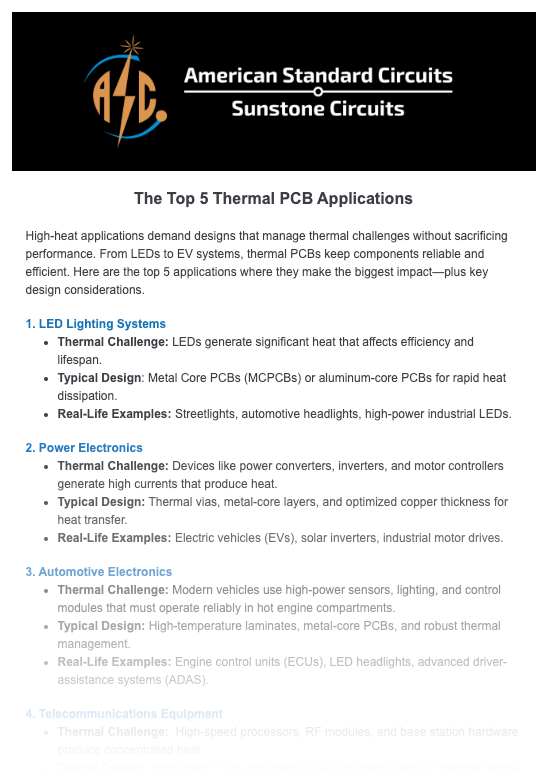
High-heat applications demand designs that manage thermal challenges without sacrificing performance. From LEDs to EV systems, thermal PCBs keep components reliable and efficient. Here are the top 5 applications where they make the biggest impact—plus key design considerations.
View NewsletterFrom Aerospace to 5G—Ultra HDI Delivers
In this issue:
Are you working with 5G, radar, aerospace, or high-speed data links? These RF applications demand fidelity and miniaturization and Ultra HDI technology delivers. As the applications become more complex, the need for tighter design tolerances is clear.
View NewsletterSept. 2025: From Aerospace to 5G—Ultra HDI Delivers
In this issue:
Are you working with 5G, radar, aerospace, or high-speed data links? These RF applications demand fidelity and miniaturization and Ultra HDI technology delivers. As the applications become more complex, the need for tighter design tolerances is clear.
View NewsletterAugust 2025: Mastering Flex Stiffness
In this issue:
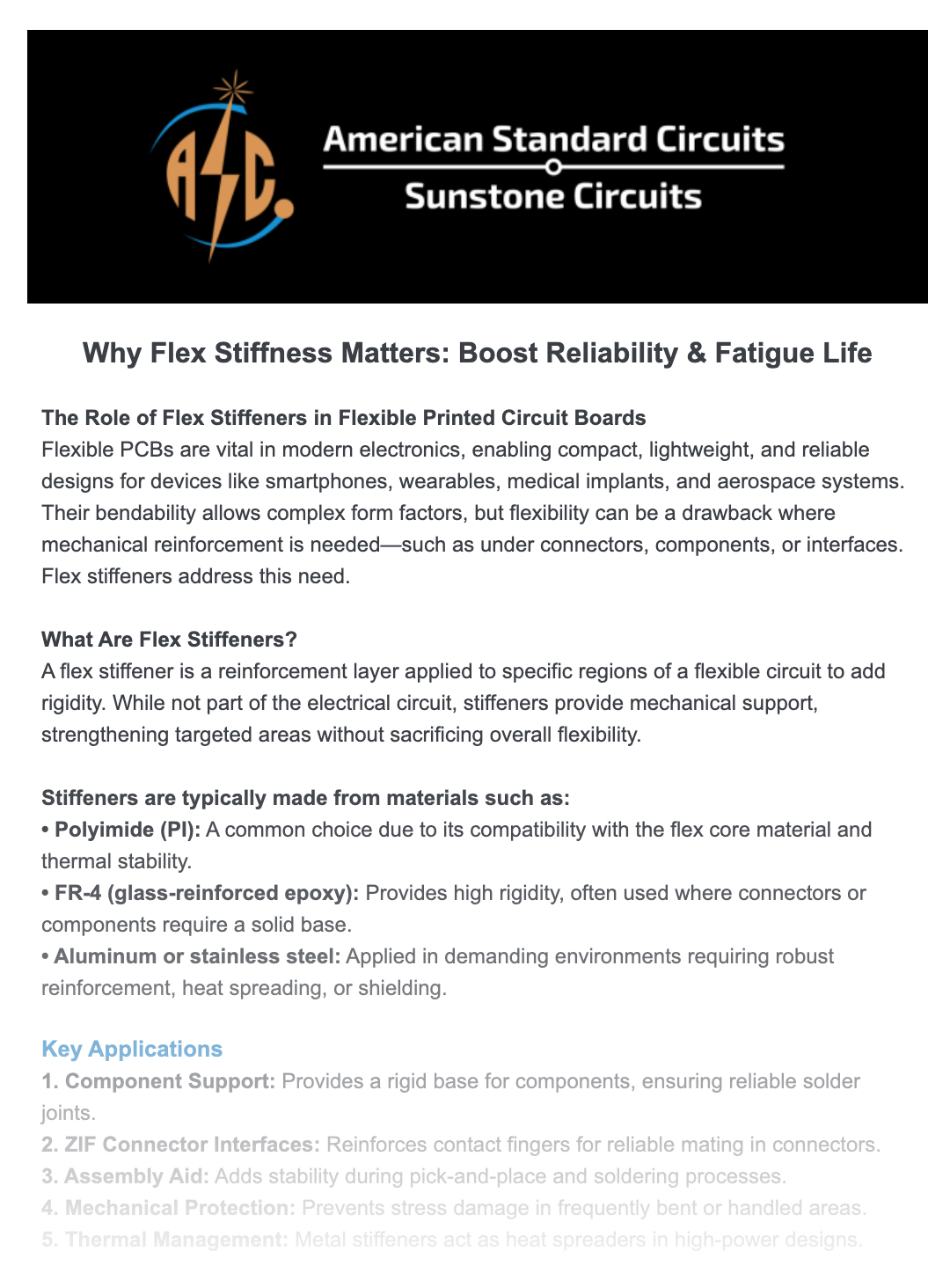
A complete guide to using flex stiffeners, a reinforcement layer applied to specific regions of a flexible circuit to add rigidity. While not part of the electrical circuit, stiffeners provide mechanical support, strengthening targeted areas without sacrificing overall flexibility.
View NewsletterAugust 2025: Ultra HDI for Flex & Rigid-Flex
In this issue:
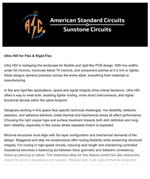
Ultra HDI is reshaping the landscape for flexible and rigid-flex PCB design. With line widths under 50 microns, microvias below 75 microns, and component pitches at 0.3 mm or tighter, these designs demand precision across the entire stack, everything from materials to manufacturing.
View NewsletterJuly 2025: Thermal PCBs: Advanced Materials. Superior Heat Dissipation

In this issue:
Thermal PCBs are specially engineered to manage and dissipate heat generated by high-power electronic components. They're essential in applications where traditional FR4 PCBs would fail due to thermal stress, such as LED lighting, power electronics, and RF systems. Thermal PCBs are designed specifically to manage and dissipate heat generated by active components. They typically incorporate:
View Newsletter
July 2025: An Ounce of Prevention With Ultra HDI

In this issue:
Medical electronics demand miniaturization, reliability, and precision. For next-generation devices, Ultra High-Density Interconnect (UHDI) technology is a game-changer. Implantables, wearables, and diagnostic tools can be smaller, lighter, and smarter - without sacrificing signal integrity or performance.
View NewsletterJune 2025: From Concept to Production: Master the Art of Manufacturable PCB Design
In this issue:
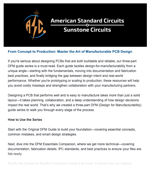
A three-part DFM (Design for Manufacturability) guide series to walk you through every stage of the process.
View Newsletter
June 2025: June 2025: Designing Flex for Success
In this issue:
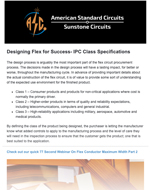
Explanation of the critical importance of the design phase in flex circuit manufacturing and introduces a three-tier product classification system.
View NewsletterJune 2025: Next-Gen Reliability Starts with UHDI
In this issue:
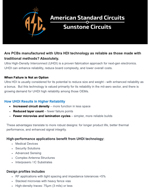
- Are PCBs manufactured with Ultra HDI technology as reliable as those made with traditional methods?
- Test your knowledge: UHDI quiz
- UHDI Resources
May 2025: Big News: We've Upgraded for Speed and Accuracy

In this issue:
Announcing ASC's latest production upgrade: the Pluritec X-CUT S1, as part of their commitment to staying current with evolving PCB technology.
View NewsletterMay 2025: Beyond the Trace: Mastering Soldermask in Ultra HDI Design
In this issue:
Soldermask challenges in Ultra HDI PCB designs, explaining that soldermask becomes a limiting factor at 25 μm spacing or less.
View NewsletterApril 2025: ASC’s Investment In Equipment Sets The Standard
In this issue:
Advanced CNC Machining for High-Performance PCBs leads to faster turnaround times, cost savings, better quality, and more!
View NewsletterApril 2025: Tired of Overheating? Discover MCPCB Solutions

In this issue:
As the demand for high-power electronics continues to grow, metal-backed printed circuit boards (PCBs) have become a go-to solution for industries requiring superior heat dissipation, structural integrity, and performance reliability.
View NewsletterApril 2025: Copper Filled Vias for UHDI

In this issue:
As PCB technology advances, Ultra HDI (Ultra High-Density Interconnect) designs are driving the demand for finer lines, denser layouts, and innovative via structures. One critical aspect of Ultra HDI design is the use of copper-filled vias, particularly in Via-In-Pad-Plated-Over (VIPPO) structures. Optimizing these features requires careful design considerations to ensure manufacturability, reliability, and performance.
View NewsletterMarch 2025: Collaboration is Key to Designing Complex RF Antenna PCBs

In this issue:
We often urge “early and often” engagement between the pcb fabricator and the designer, whether they are an OEM, ODM or contracted design service. This rule of thumb is even more critical when working with complex RF antenna designs as the workflow to this technology has so many factors.
View NewsletterMarch 2025: ASC’s R&D Solves PCB Challenges
In this issue:
At American Standard Circuits, we don’t just manufacture PCBs—we focus on engineering solutions. Our commitment to ongoing research and development ensures that even the most complex design challenges are met with innovation, precision, and reliability.
View NewsletterMarch 2025: Pushing PCB Limits: Ultra HDI and the Future of Density
In this issue:
Traditional HDI technology is evolving. Historically, these designs have been limited to microvia sizes of around 4 mils, with capture pads typically 8–10 mils larger. Now, advancements in Ultra HDI technology are redefining these limits, enabling unprecedented density and performance capabilities
View NewsletterFebruary 2025: Revolutionizing SWaP with Ultra HDI Technology
In this issue:
Ultra HDI (UHDI) technology is transforming our approach to challenges in Space, Weight, and Power (SWaP). It is not just an innovation – it is a necessity for staying ahead of your competition. Here are just a few exciting examples of how Design and Fabrication experts are applying UHDI today.
View NewsletterFebruary 2025: Optimizing Flex PCBs: The Impact of Staggered vs. Stacked Conductors
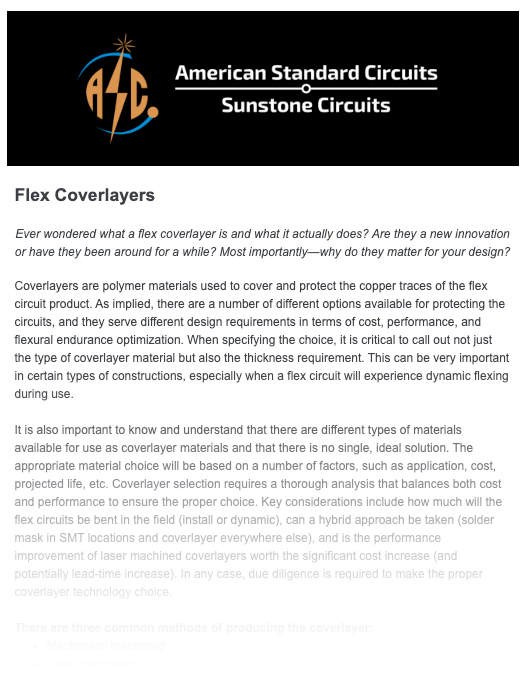
In this issue:
Ever wondered what a flex coverlayer is and what it actually does? Are they a new innovation or have they been around for a while? Most importantly—why do they matter for your design?
View NewsletterFebruary 2025: RF PCB Layer Stackup
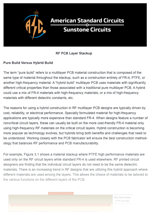
In this issue:
The term “pure build” refers to a multilayer PCB material construction that is composed of the same type of material throughout the stackup, such as a construction entirely of FR-4, PTFE, or another high-frequency material.
View NewsletterJanuary 2025: A $31,800 Success Story: Helping a Customer Save Big

In this issue:
Recently, ASC Global Sourcing partnered with a major OEM in the HVAC industry to deliver significant cost savings and exceptional results. This project was a test of our capabilities, as the OEM had always sourced domestically and doubted offshore suppliers would be interested in a low-volume, small part. We proved them wrong.
View NewsletterJanuary 2025: Thermal Benefits of MCPCBs
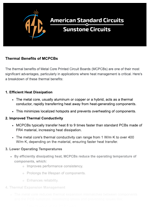
In this issue:
The thermal benefits of Metal Core Printed Circuit Boards (MCPCBs) are one of their most significant advantages, particularly in applications where heat management is critical. Here's a breakdown of these thermal benefits:
View NewsletterJanuary 2025: Exploring UHDI PCB Fabrication
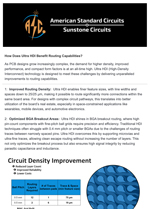
In this issue:
Discover how Ultra HDI technology can help you unlock greater routing capabilities, optimize BGA breakout areas, and reduce costs.
View NewsletterJanuary 2025: Fundamentals of RF/Microwave Chapter 2

2024 Holiday Message from our CEO
In this issue:
. As we look to 2025, we’re excited to continue delivering the innovative PCB technology solutions you rely on to drive your success.
View NewsletterDecember 2024: Exploring UHDI PCB Fabrication
In this issue:
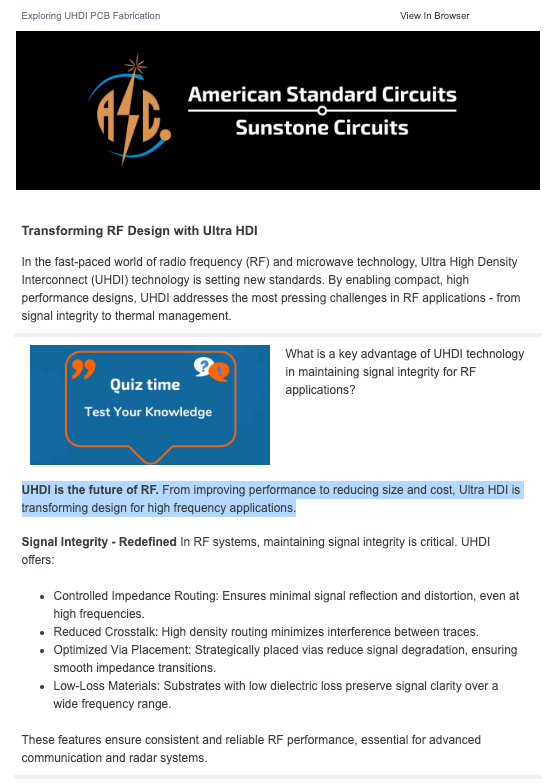
UHDI is the future of RF. From improving performance to reducing size and cost, Ultra HDI is transforming design for high frequency applications.
Take our quiz and test your UHDI knowledge.
View NewsletterNovember 2024: Unlock Global Savings Beyond China with ASC Global Sourcing
In this issue:
- Examples of cost-effective, high-quality products sourced from regions beyond China
November 2024: Expert Insights: Exploring Ultra HDI PCB Fabrication

In this issue:
- Navigating Technology Choices: It All Depends On Your Desired Results
- Current Projects in Progress at ASC
- Test your UHDI knowledge
October 2024: Fundamentals of RF/Microwave PCBs
In this issue:
Chapter 1 of our eBook, The Printed Circuit Designer's Guide To...Fundamewntals of RF/Microwave PCBs, Material Selection
View NewsletterOctober 2024: Gain an Edge in Medical Device Design: Partnering Early with PCB Fabricators
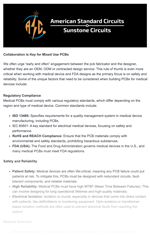
In this issue:
- ASC Sunstone Case Study: Innovative Medical Pill Camera Production with Flex/ Rigid-Flex PCB Introduction
American Standard Circuits Advanced DFM Capabilities
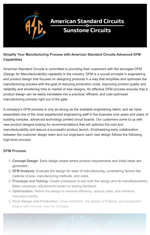
August ASC Newsletter
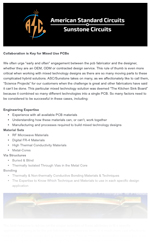
In this issue:
- Collaboration is Key for Mixed Use PCBs Whitepaper
- 77-second Wewbinar: The Kitchen Sink Board
August 2024 Global Sourcing Newsletter
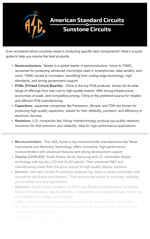
In this issue:
- A quick guide to help you source the best products
- Our gloibal sourcing capabilities
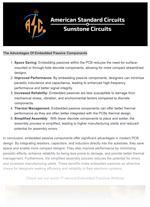
The Advantages Of Embedded Passive Components
In this issue:
- The Advantages Of Embedded Passive Components
- 77 second embedded passives video webinar
- Free PCB resources
July 2024 Global Sourcing Newsletter

Thermal LED PCB Applications

Ultra HDI Ask The Experts Series: Featuring Nava Shpaisman
In this issue:
- Q & A with Nava Shpaisman, a senior research scientist with an in-depth understanding of the global advanced PCB and ICS markets and technology trends.
Ultra HDI Ask the Experts Series: with Paul Cooke

In this issue:
- Q & A with Paul Cooke, Director of Application Engineering, AGC Multi Material America, Inc
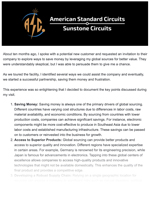
Mastering Global Sourcing: Lessons Learned and Best Practices Shared
June ASC Newsletter
Collaboration is Key to Designing Thermal PCBs

June 2024 UHDI Newsletter
June 2024 RF/Microwave Newsletter

May 2024 Global Sourcing Newsletter

May 2024 ASC Newsletter
In this issue:
- President's message
- A note from our suppliers
- 77 Second Webinar- Embedded resistors
May 2024 UHDI Newsletter

April 2024 Global Sourcing Newsletter

March 2024 ASC Newsletter

March 2024 Global Sourcing Newsletter

March 2024 UHDI Newsletter
In this issue:
- Similar but Different: Building to Designer Intentions
- UHDI capabilities
January 2024 Global Sourcing Newsletter
ASC January 2024 Newsletter
January 2024 UHDI Newsletter
In this issue:
Design guidelines from experts
Whitepapers from Eric Bogatin
UHDI design tips
View Newsletter
December 2023 ASC Newsletter
UHDI December 2023 Newsletter

November 2023 ASC Newsletter
November 2023 Global Sourcing Newsletter
In this issue:
- President's Message
- Advantages of Global Sourcing
- Case study: $73K of savings
May 2023 UHDI Newsletter
November 2023 UHDI Newsletter

October 2023 ASC Newsletter
In this issue:
- President's Message
- Insulated Metal Printed Circuit Boards
- Upcoming Events
October 2023 Global Sourcing Newsletter
October 2023 UHDI Newsletter
In this issue:
- Featured Interviw with Daniel Beeker
- Technology highlight
- Ultra HDI FAQ
September 2023 Newsletter
Newsletter UHDI September 2023
September 2023 Newsletter: Global Sourcing
In this issue:
- Case Study: Leave it to the Pros
- Why is ASC Global Sourcing the best?
ASC August Newsletter -- Flex & Rigid - Flex

In this issue:
- President's Message
- Article: Separation Distance Between Flex Circuit Cores
August 2023 Global Sourcing Newsletter
UHDI Newsletter July 2023

ASC Special Newsletter: ASC Acquires Sunstone Circuits
Summer 2023 ASC Newsletter
In this issue:
- Message from our CEO
- Featured DFM 101 articles
- Featured columns from our experts
June 2023 Global Sourcing Newsletter

April 2023 Global Sourcing Newsletter

May 2023 Newsletter
June 2023 UHDI Newsletter
April 2023 UHDI Newsletter
March 2023 Newsletter

In this issue:
- Message from our CEO
- Upcoming Webinars
- ASC Featured news, articles and columns
February 2023 Newsletter

In this issue:
- Message from our CEO
- Upcoming Webinars
- Benefits of A-SAP technology
- Interview with ASC Expert on A-SAP
January 2023 Newsletter

December 2022 Newsletter

In this issue:
- Message from our CEO
- Global Sourcing Division announcement
- Interview with Bob Duke, President of ASC's new Global Sourcing and Supply Chain Division
November 2022 Newsletter

In this issue:
- Message from our CEO
- Focus on A-SAP™
- Interview with John Johnson, New Director of Business Development at ASC
October 2022 Newsletter
In this issue:
- Message from our CEO
- Featured article: Designing for Bending
- Upcoming trade shows and webinars
September 2022 Newsletter

In this issue:
- Message from our CEO
- Featured columns
- ASC News
- Upcoming trade shows and webinars
August 2022 ASC Medical Newsletter

In this issue:
- Message from our CEO
- Medical Case Study
- Upcoming trade shows and webinars
July 2022 ASC Newsletter

In this issue:
- Message from our CEO
- Embedded Coin Technology article
- Upcoming trade shows
Summer 2022 ASC Newsletter
May 2022 RF Newsletter
In this issue:
- Message from our CEO
- Articles on RF materials selection
- Upcoming webinars
May 2022 Newsletter
In this issue:
- Message from our CEO
- New video on Flex/Rigid Flex Impedance
- Upcoming webinars for Flex professionals
March 2022 Newsletter
In this issue:
- Message from our CEO
- Featured columns
- Not one but two articles from our DFM 101 series
February 2022 Newsletter

In this issue:
- Message from our CEO
- Upcoming webinars
- Pedestal Technology for High Power LED's
January 2022 Newsletter

In this issue:
- Message from our CEO
- Upcoming webinars
- Featured article on Z-axis interconnects
December 2021 Newsletter

November 2021 Newsletter

In this issue:
- Message from our CEO
- Article: What is Embedded Passive Technology?
- Our Latest 77 second Webinar
October 2021 Newsletter
In this issue:
- Message from our CEO
- Meet John Bushie
- Our Latest Bleeding Edge Webinar
September 2021 Newsletter
August 2021 Thermal Newsletter
Summer 2021 Newsletter

June 2021 Newsletter
In this issue:
- Message from our CEO
- A-SAP Technology
- Upcoming webinars and much more!