Copper Weights on All Layers
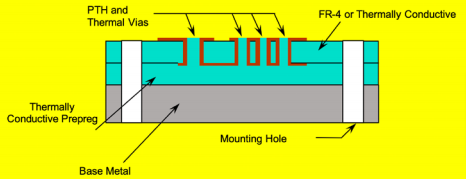
The thicker the copper, the more expensive, and remember that the outer two layers will get additional copper since the vias will need to be plated. Lines and spaces should follow the design guidelines of the PCB fabricator based on the copper weights of each of the layers. Double-Sided/Multilayer Construction It is important to decide whether you can use FR-4 for your multilayer construction or if you require thermally conductive prepregs and cores. If you need thermally conductive cores and prepregs, there are a number of options available, but core thicknesses are limited, so it is best to work with the PCB fabricator or laminate supplier on constructions that would make sense. The prepregs tend to be low flow, so it is important to work with a PCB fabricator that understands the press cycles and flow dynamics of the specialty prepreg that need to be used. Thermally Conductive Prepreg Choose the prepreg to bond the PCB (double-sided or multilayer) to the metal based on thermal conductivity required and thickness of the copper circuitry.
From a PCB manufacturing perspective, several different factors need to be taken into account for in the process of bonding the PCB to base metal:
∎ Ensure that you don’t have delamination between the PCB and the metal. There are design factors that can impact this and process conditions in the lamination process
∎ Have a method to control the flow of the prepreg through the plated through-holes (PTHs) to the top side, and then have a method to remove any flow that ended up on the top surface of the PCB
∎ There are a number of mismatched CTEs in this package. It is important to balance the copper in the construction as much as possible from a PCB perspective and have a press cycle that minimizes warpage
Base Metal
Aluminum is the most common; however, there are many applications that will also use copper as the base metal. In general, for this kind of construction, if aluminum is the metal of choice, I recommend using the 6061T6 alloy.
Excepted from The Printed Circuit Board Designer’s Guide To Thermal Management.